














(Rochester, NY)… The Rochester Knighthawks players and staff stepped back in time on Monday as they toured Ganondagan State Historic Site. Ganondagan Cultural Liaison Ansley Jemison, Seneca of the Wolf Clan, guided the group through the history of the Seneca and Haudenosaunee people and the origins of the Creator’s Game.
Knighthawks players Brad Gillies, Ryland Rees, Zed Williams, and Jake Piseno, along with Interim Head Coach Randy Mearns and members of the front office staff, visited the full-size Seneca Bark Longhouse and the Seneca Art & Culture Center. The 17,300-square-foot facility highlights the many contributions the Haudenosaunee have made to art, culture, and society.
The tour was part of a two-week buildup to the Knighthawks’ fifth annual Native American Heritage Game, presented by Seneca Niagara Resort & Casino. Rochester hosts the Georgia Swarm on Sunday, April 19, at 3 p.m.
“We’re in this privileged position where we can help educate the next generation,” said Mearns. “We can continue to move the game forward, but also share the message and the experience of what it truly means. It’s the Creator’s Game.”
The Knighthawks share a special connection to the Creator’s Game, as the franchise is owned by the Seneca Nation. Through its wholly owned business subsidiary, Seneca Holdings, LLC, the Seneca Nation purchased the team on Aug. 5, 2025.
The Seneca Nation is a sovereign Native nation and the largest nation within the Haudenosaunee. The Seneca people have lived on lands that now make up western New York for time immemorial and have made countless contributions to the region’s history, culture, and economy. Today, the Seneca Nation has more than 8,500 enrolled members, most of whom live on several distinct territories throughout western New York.
With the support of the Seneca Nation, this year’s Native American Heritage Game promises to be the biggest celebration yet. The April 19 event will feature an Artisan Village, traditional dancers, specialty jerseys, and merchandise celebrating Native American heritage.

Williams, Mearns, & Piseno listening to Jemison. Photo Credit/James Baehr
Upon arriving at Ganondagan, the Knighthawks were welcomed with an Edge of the Woods ceremony, a traditional Haudenosaunee protocol used to welcome visitors into a new community. The ceremony serves as a cleansing ritual meant to clear travelers’ eyes, ears, and throats of the burdens of travel so they may communicate with clarity, peace, and understanding.
Jemison explained the significance of the ceremony during the team’s arrival.
“This was once the land of the people who lived here, and we want people to know that we are still here — a living community,” he said. “The Edge of the Woods would have been our traditional way of welcoming someone onto our territory. It’s the proper way to greet visitors. We say you are guests of our territory, but you’re not just my guests — you’re also guests of future generations.
“It’s important to understand that this land doesn’t belong to any of us. One day, we’ll all be gone, and we are simply stewards of the land while we’re here. The Edge of the Woods is a good way to welcome people and share our traditional practices.”
The ceremony resonated with Mearns, who said its message aligns closely with his coaching philosophy.
“Even with the ceremony when we arrived,” said Mearns. “It talks about the eyes, the ears, and the throat — seeing clearly, listening clearly, and speaking clearly. Those are simple things you can reflect on. When you hear that, it’s reassuring. You need to see clearly, hear clearly, and communicate clearly. From a team standpoint, those are things we need to do every day.”
During the tour, Jemison walked the group through the many exhibits at the Seneca Art & Culture Center, explaining everything from the fur trade to the history of the original village that once stood on the site. One of the most interactive portions of the tour was a presentation on the Haudenosaunee Nationals and the origins of lacrosse.

Helmets from the Haudenosaunee Nationals. Photo Credit/Craig Rybczynski
“I think that was an important part of today — giving them a contemporary understanding of where lacrosse is today and where Haudenosaunee people fit into that,” said Jemison. “If you’re a lacrosse player, you’re familiar with the roots of the game, but having the opportunity to hear directly from an Indigenous person provides deeper historical context and a modern perspective.”
During the presentation, Jemison passed around four helmets worn by the Haudenosaunee Nationals during international competitions and explained their symbolism. In 2014, four years after the team was barred from traveling using their Haudenosaunee passports, the Nationals wore black helmets at the FIL World Lacrosse Championship in Denver that featured the same logo used on those passports.
Players and staff also had the opportunity to handle wooden lacrosse sticks, including one from the 1800s that belonged to William Hoag, the 12th president of the Seneca Nation. Jemison discussed how lacrosse has historically been used to resolve disputes and promote healing, often referred to as the Medicine Game. In Haudenosaunee culture, lacrosse sticks are symbolic throughout a person’s life — from cradle to grave — representing the deep connection between the game, the wood, and the natural world.
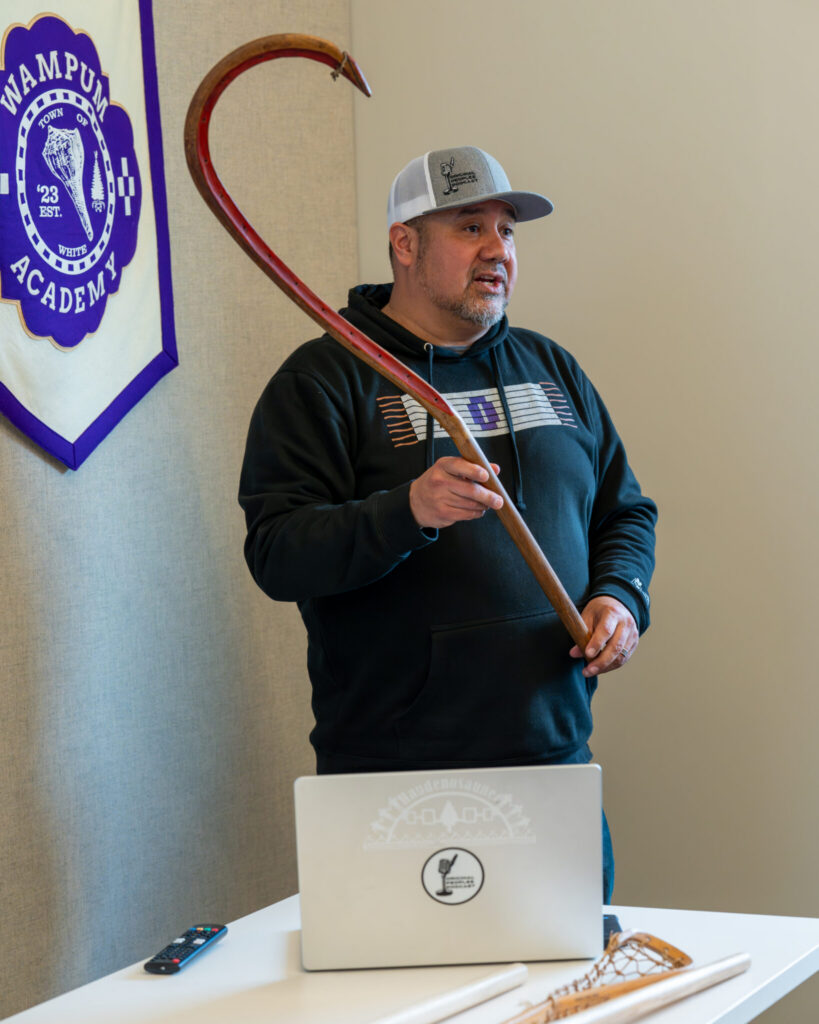
Jemison presenting President Hoag’s stick, found in Irondequoit, NY. Photo Credit/James Baehr
The experience was particularly meaningful for Williams, Seneca of the Wolf Clan, who brought his two young daughters with him.
“It’s in their blood,” said Williams. “Seeing this side of their culture — where their grandfather, my dad, and their mom are from — it’s a big part of who they are. I’m always going to make sure they know the Seneca Nation and understand their Native roots.”
Williams said the visit served as an important reminder of the responsibility players carry as role models.
“Being here reminds you that no matter how unfair life can be sometimes, you still have a job to do,” he said. “You still have kids to take care of and younger lacrosse players to mentor. One of the things I love about our Native culture is that it emphasizes peace and healing — and that’s what the game of lacrosse represents.”
One of the younger players Williams has mentored through the Haudenosaunee Nationals program is Piseno, now his teammate in Rochester. In 2023, Piseno represented the Haudenosaunee at the World Lacrosse Championship, earning All-World Team honors and being named the tournament’s Best Defender. In 2025, he also competed with the national team at the Atlas Cup and the Super Sixes.
Piseno’s own journey of discovering his Native heritage is still ongoing. He learned during his senior year of high school that he has Purépecha ancestry. His people are recognized as an Indigenous tribe of the first North America. Although not part of the Haudenosaunee Confederacy, Piseno has embraced learning about Indigenous cultures and their histories.
“My dad and I always thought we were Mohawk,” said Piseno. “It wasn’t until we started digging deeper that we discovered more about our background. I learned that my tribe was the only one not conquered by the Aztecs. I’m still learning about the culture and the values, so this tour was really educational for me.”
Jemison said he appreciated the opportunity to bring the players together for an open conversation about identity, culture, and the shared bond of lacrosse.

Jemison showing a wampum belt in the Culture Center. Photo Credit/James Baehr
“I was fortunate to have the experience of being part of the Haudenosaunee Nationals and traveling the world representing our people,” he said. “To be able to share that experience with players who have competed against us — like Ryland with Team Canada. To have Jake Piseno, who is now a member of the Haudenosaunee Nationals, and Zed Williams together in a room — it creates a real opportunity for meaningful conversation about Indigenous identity today.
“It can be complicated at times, but there is also a great sense of pride in our culture and who we are. Sharing that pride and history with our brothers in the game — and especially with those who may not be Native — is incredibly important.”
For Gillies, the visit served as both a learning experience and a reminder of the responsibility he carries within the lacrosse community.
“I need to continue educating myself about Native American culture,” he said. “There’s so much that I still don’t know. Understanding not just the roots of the game, but the culture behind it, is really important to me.”
Rees also stressed the relevance and importance of the tour and learning about the Haudenosaunee.
“It was an incredible experience,” he said. “To not only hear about the history of the game of lacrosse and the traditions of the game, but to really learn about the history of the Six Nations and the Rochester area was what was so interesting to me.”