














(Rochester, NY)… The life of an athlete has many phases. It usually starts in youth sports, then moves into playing for your school. If you’re good enough, you might get the chance to compete in college. If you’re one of the best there, you get to play in the pros.
Throughout all of those parts of an athlete’s life, there are usually a set of very proud parents sitting in the stands every step of the way. At some point, though, the athletes go from being children to becoming parents themselves. That step for a player can be life-changing.
That’s the case for nine Knighthawks: Connor Fields, Brad Gillies, Matt Gilray, Riley Hutchcraft, Taylor Jensen, Ian Llord, Jeremy Thompson, Chad Tutton, and Zed Williams.
Every parent is different and gets different lessons from their children. For Llord, his first child came at a turning point in his lacrosse career.
“My focus and my drive kind of changed,” Llord said. “Right after I had Hudson, I was also let go by Buffalo. It was at the end of the year, but then I got picked up by Rochester. There was a gap where I didn’t know if I’d play again. That was about six years into my career, I said, ‘Oh, maybe this just isn’t for me anymore, and I’m going to move on,’ but then my wife said, ‘I think you should put at least an effort in, and then maybe let this kid see you play,’ Obviously she had some kind of faith in me that I wasn’t really having in myself at the time.”

“So, yeah, it kind of gave me more of a drive, and that news coming at the time, Hudson coming along was almost the perfect thing to kind of get me back up and going again.”
Llord found a new purpose when he became a dad. It ultimately drove him to Rochester the first time around.
Jensen was in Rochester when he became a dad. While still in school, he had a lot to handle.
“It did really put things into perspective,” Jensen said. “I thought I was able to focus more on the things that I wanted to focus on. After I had Aisling, I made the dean’s list every year, which I’d never done before. And my lacrosse started to take off, too. I was starting to do a lot better. I definitely think it helped me to kind of focus on the things that I really held close to my heart.”
Jensen and Llord both found themselves as dads at crucial points in life, and there’s no doubt their families helped them find the best way through it. For someone like Gillies, who works with youth in lacrosse almost every day, having a child of his own changed things in a different way.
“It’s more so just prioritizing things, I guess that would be the biggest shift,” Gillies said. “Knowing that takes such a big precedent over everything else, so all other priorities kind of shift down one. You definitely have to be smarter with your time and smarter with your training and just be more thoughtful about how you do things.”
Gillies brings home the trifecta of what becoming a parent can do to a professional athlete. They gain a different perspective as a parent. It gives them that other type of drive. The key is then to prioritize making sure they are both the best parent and the best athlete possible.
SETTING THE EXAMPLE
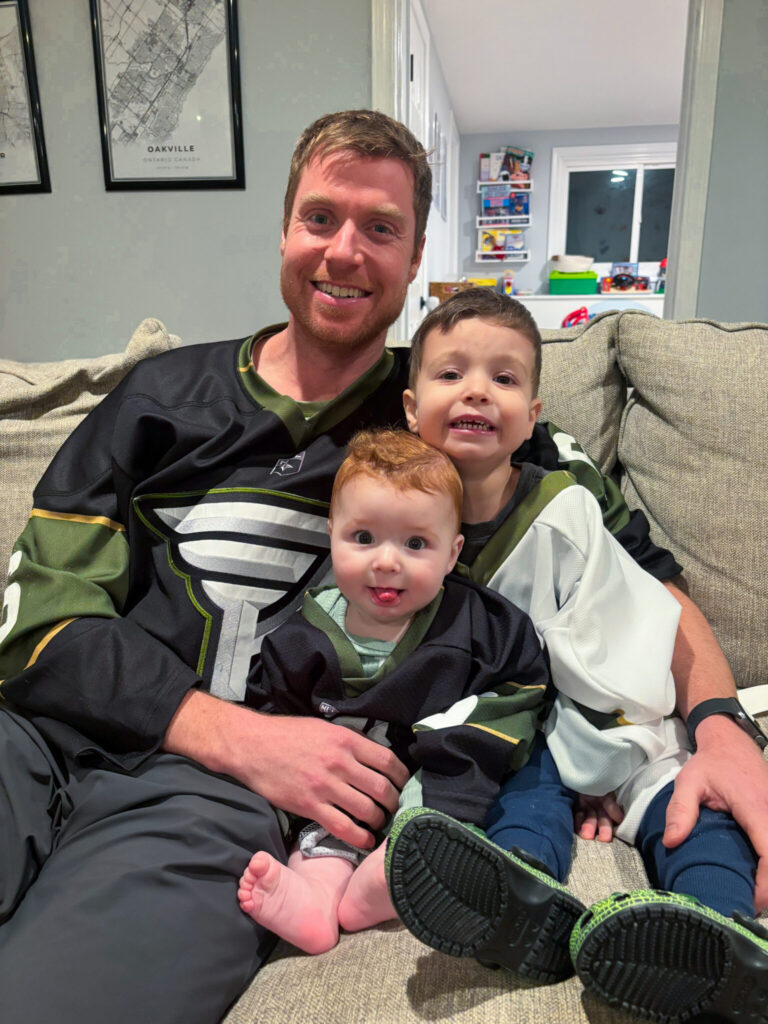
Dads are often one of the biggest role models for their kids growing up; the Knighthawks are no different. However, they also understand the pressure on their kids, who are raised by professional lacrosse players.

“I hope so,” Jensen said about being a role model for his daughter while playing a game. “I’m pretty lucky, I’m one of the younger guys on the team who has a kid, and Aisling is probably one of the oldest kids. So she’s still going to be able to see me and be older and understand more of it.”
“I hope she looks up to me and I hope she understands it, but also, I don’t want to put too much stress into that because regardless of if she plays lacrosse or other sports or anything else, I also want to be a role model for that.”
Hutchcraft feels the same way with his two kids, whether they get to watch a game from the stands or greet him when he comes home after they watch him on TV.

“I think it’s good to have that aspect, looking down and seeing dad out there competing at the highest level,” Hutchcraft said. “I’ll support my children with whatever they decide to do, but as long as they see me competing and giving it my best every single time I do something. I think it helps, and it shows them that whatever you do, you gotta compete and you gotta do it to the best of your abilities.”
Most lacrosse players already understand that when they step on the floor, they are role models for another generation of athletes. For an NLL player who is a parent, it’s just another level deeper.
BETTER FOR IT
In sports, dad strength is no secret. With all those lessons of fatherhood, it seems hard to say that becoming a dad doesn’t make an athlete better in their sport.
“Being a young dad too when I had Hudson, it gave me a new sense of purpose in my lacrosse, it really righted the ship for me,” Llord said. “Then, when my daughter came around, I found my patience became a lot more. And then for me personally, it made me realize, when I was teaching them stuff about the game or just in general, then that was stuff I was never even thinking about.”
Llord’s son and daughter being older allowed him to teach the game again and grow it for himself. For Williams, earlier in his career, his daughters helped him find his formula.

“Being a dad definitely drove me to be a better lacrosse player and helped my career,” Williams said. “Especially being a stay-at-home dad with the girls and taking them to the gym all those years, every day, as that was our routine.”
For a dad whose child is younger, Gillies hopes to keep playing for his son so his son has the same opportunity as Llord and Williams.
“I think it’s definitely helped motivate me and made me want to keep going,” Gillies said. “I’d say one of my goals is to play long enough that he understands kind of what I’m doing. So, as far as motivating me to stay fit and continue to try to play at a high level, I would say yes.”